Simon Import Solutions
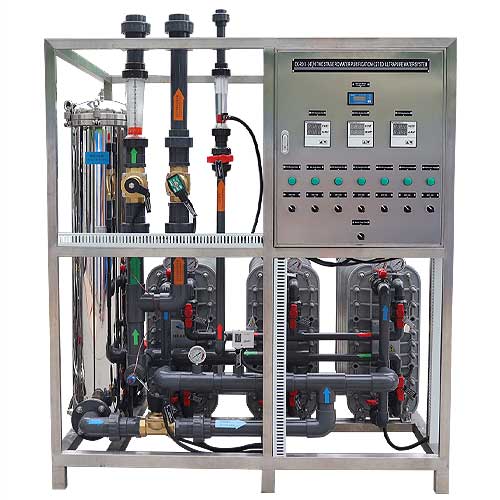
Industrial Electrodeionization (EDI) System for Ultrapure Water
Industrial Electrodeionization (EDI) System for Ultrapure Water
Continuous production of ultrapure water up to 18.2 MΩ/cm, without the use of chemicals.
Electrodeionization (EDI) systems continuously remove ions from water without the use of chemicals. Typically used after reverse osmosis (RO) systems, EDI modules produce ultrapure water with a quality of up to 18.2 MΩ/cm.
What is an EDI system?
Electrodeionization (EDI) is an electrically driven water treatment technology that uses direct current (DC), ion exchange resins, and selective membranes to remove dissolved ions from water.
What does an EDI system remove?
- Dissolved salts
- Organic acids
- Mineral ions
- Other ionized and ionizable species
How does an EDI system work?
An EDI module consists of chambers filled with ion exchange resins, separated by selective membranes. When water enters the system, an electric field forces ions to migrate through the resins and membranes, separating them from the purified water.
Removed ions are directed to reject streams, while treated water can be used directly or subjected to additional stages to achieve an even higher level of purity.
The EDI system acts as an ion exchange bed continuously regenerated by electricity, eliminating the need for chemical regeneration with acid or caustic soda.
Technical Specifications
- Capacity: up to 50 m³/h
- Produced water quality: up to 18.2 MΩ/cm
- Inlet water conductivity: < 40 µS/cm
- Control system: automatic
Advantages of the EDI system
- Continuous production of ultrapure water
- No chemicals used
- Low operating cost
- High energy efficiency
- Lower maintenance requirements
- Environmentally friendly solution for water deionization
Applications
- Pharmaceutical industry
- Electronics production
- Power plants
- Laboratories
- Industrial processes requiring ultrapure water
Summary
The electrodeionization (EDI) system is an advanced and efficient solution for producing ultrapure water, ideal as a final stage after RO systems. It offers continuous operation, without chemicals, with high water quality and low operating costs.
Partilhar